
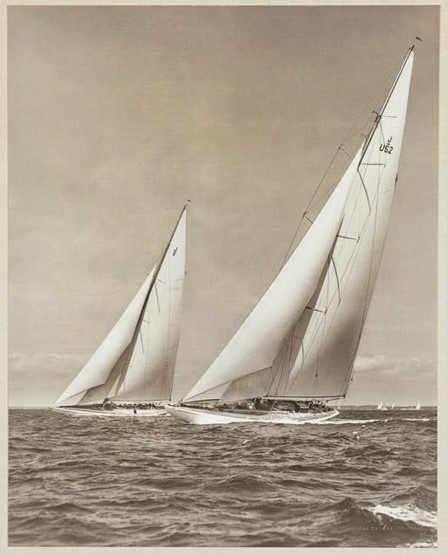
In the history of the America’s Cup, sailing with the J-Class yachts stands out as a highlight. It was also the pinnacle for “The Norwegian Steam”—the sailors from south-west Norway, the island of Tysnes in particular, and their reputation as a world-class crew.
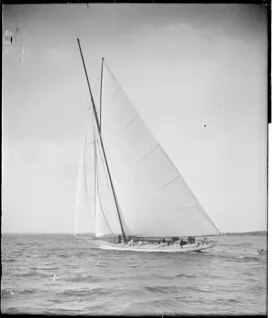
The J-Class is considered by many to be among the most beautiful sailing yachts ever built. Their sleek lines and the seamanship required to sail them remain fascinating to this day. The 1930s marked their heyday. From 1930 onwards, the yachts built to compete for the America’s Cup followed new guidelines designed to make them more standardized and modern—giving rise to the J-Class. The most visible difference from the preceding class was the adoption of a Bermuda rig, replacing the earlier gaff rig. The last yacht to win the America’s Cup in the previous class was «Resolute» in 1920. One-third of her crew hailed from Tysnes, including First Mate Engel Vaage and Second Mate Gunnar Gjerstad. The reputation of “The Norwegian Steam” was thus well established by the time crews were being assembled for the yachts of the new class.
A short but magnificent era
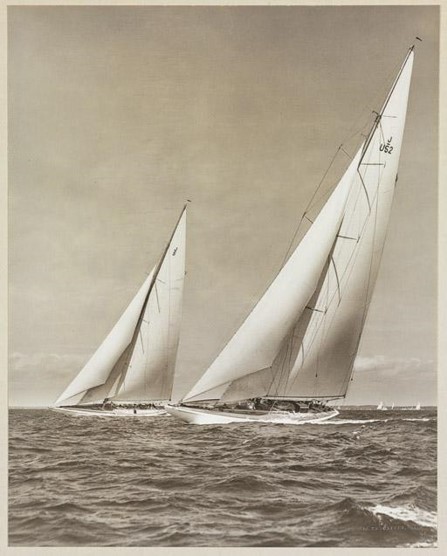
A J-Class yacht was required to have a waterline length of between 76 and 87 feet (23–26.5 m) and an overall length of between 120 and 135 feet (36.5–41 m). The mast stood over 50 meters tall and carried a sail area of nearly 700 m². In addition, there was the spinnaker, which could be twice that size. Ranger—winner of the 1937 America’s Cup—carried a spinnaker measuring a massive 1,672 m², enough to cover two handball courts. A crew of around 25 was required to sail these vessels. Ten J-Class yachts were built in the 1930s: six in the USA—Enterprise, Weetamoe, Whirlwind, Yankee, Rainbow, and Ranger—and four in Great Britain—Shamrock V, Velsheda, Endeavour, and Endeavour II. Additionally, some older boats were converted to the J-Class: Vanitie and Resolute in the USA, and White Heather II, Britannia, Astra, and Candida in Great Britain. At that time, only these two nations competed for the America’s Cup, with regattas held in 1930, 1934, and 1937. “The Auld Mug,” as the trophy is affectionately known, is the world’s oldest existing sports trophy. It is named after the yacht America, which won what is considered the inaugural race in 1851. The Americans dominated from the start, and a full 132 years would pass before their winning streak was broken. In 1983, an Australian boat finally brought the perpetual trophy home to another nation.
The J-Class yachts competed for a mere eight years; it all came to an end after the 1937 America’s Cup. World War II brought an abrupt halt to the era, and by 1940, several of the boats had been scrapped to provide steel and lead for war materials. Others were left to rot as wrecks. However, in recent years, the class has experienced a renaissance—as we shall see.
The World’s Most Expensive Hobby
Building, manning, and sailing these vessels was not a pursuit for just anyone. In today’s money, building a J-Class yacht would cost between USD 10 million and 20 million (NOK 100–200 million), with annual operating costs of USD 3 million (NOK 30 million). It is not without reason that this has been called the world’s most expensive hobby. The book «Enterprise to Endeavour» (Ian Dear, 2004) cites a remark made during a discussion about these staggering costs: “If a fellow starts asking how much it costs to go yacht racing, the answer is that he can’t afford it!” It is also telling that Harold S. Vanderbilt—perhaps the most famous American industrial tycoon of the era—spearheaded the construction of all three boats that won the America’s Cup in the 1930s: Enterprise (1930), Rainbow (1934), and Ranger (1937). This was a pastime reserved for the super-rich, standing in stark contrast to the hardships many endured during the Depression. The income earned by the crews hired for these boats was all the more welcome. This is detailed in a series of articles about “The Norwegian Steam,” published in the Norwegian periodical «Seilmagasinet» in the spring of 2005 and written by Kjell Magnus Økland. In the series, he interviews individuals such as Olav Lunde (1913-2004), who served as a crew member on the tugboat for the yacht Whirlwind in 1930. “Those of us who got to work on the racing circuit were incredibly lucky,” he recounts. “The pay was excellent, and the early 1930s were a time of depression and very hard times. But in fact, the harsh 1930s weren’t quite so hard on Tysnes, since a lot of money was coming in from yacht sailing in the US,” recalls Olav Lunde.
Several Tysnes Natives on Winning Boats
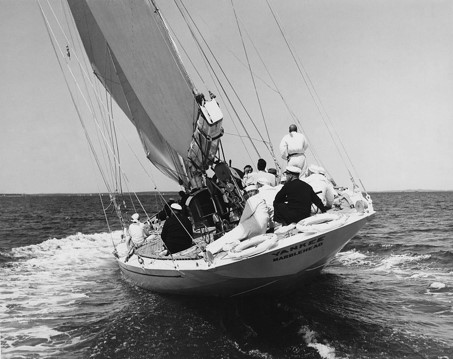
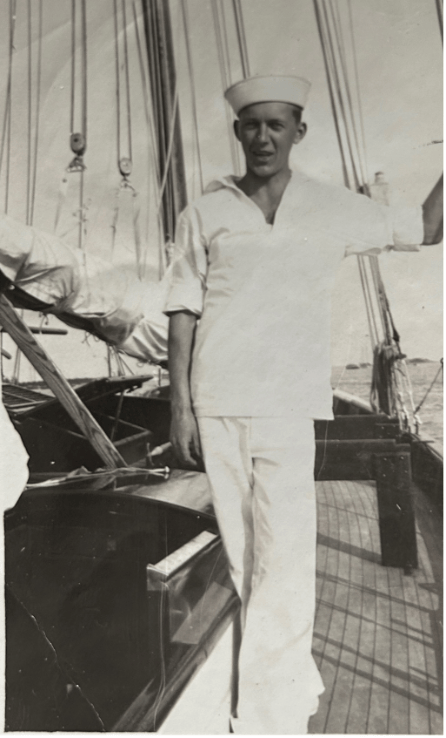
The America’s Cup is contested by just two boats—one from each nation—in a format known as match racing. In the 1930s, the duel for the trophy took place off the coast of Newport, Rhode Island, in the northeastern United States. Qualifying regattas were held to determine which boat would compete. “The Norwegian Steam”—led by sailors from Tysnes—made up a significant contingent of the crews on the American boats (see the crew list here on the website). Many consider this a key reason why American boats dominated during the 1930s. Several Tysnes natives helped win the trophy. Knut Berentin Bruntveit from Reksteren was on the winning boat in every competition during the 1930s: Enterprise in 1930, Rainbow in 1934, and Ranger in 1937. Others aboard Enterprise in 1930 included Torbjørn Hansson Heie, Lars Andreas Hope, Olai L. Hope, Torvald Berntin Hope, and Wilhelm A. Hope. The crew of Rainbow in 1934 also included Gunnar Henning Færevåg (see below), Karl Martin Lunde, and likely Sverre Mollevik. Karl Martin Lunde and—in all likelihood—Arne Jensen were on board Ranger in 1937.
However, there could easily have been more trophy winners from Tysnes. During the 1934 selection trials, Yankee—the foremost “Tysnes boat” of them all—missed out on victory over Rainbow by a mere second. You can read more about this dramatic episode in other articles on the Jaattlaget website.
When Vanderbilt Went Below Deck and Rainbow Won
In the previously mentioned article series in «Seilmagasinet», Kjell Magnus Økland interviewed Gunnar Henning Færevåg (1913–2008). Gunnar was one of the last surviving individuals who could recount firsthand experiences from on board and was among the sailors from Tysnes who took part in winning the America’s Cup. During the 1934 competition, Gunnar explains, Rainbow was trailing the British yacht Endeavour after the initial races. “After we lost the first two races, everyone was downcast—Vanderbilt especially. As we were so far behind, Sherman Hoyt 1 took command. Vanderbilt then told us not to listen to him anymore. He then went below deck to have lunch,” Gunnar recalled. Rainbow won the next four races, ensuring that “The Auld Mug” once again remained in American hands.
1 Hoyt was a legendary yacht skipper and a superstar in the sailing world for many decades.
The superior Ranger
For the 1937 competition, revised regulations were introduced requiring the rig to weigh at least 2.9 tonnes. These increased specifications were intended to prevent the frequent dismastings that had plagued J-Class yachts—particularly during the 1935 racing season in British waters (known as the “British Big Class Season”). Yankee was among the boats affected—an incident we have previously covered on the Jåttlaget website. For what would prove to be the final America’s Cup contested by J-Class yachts, Harold Vanderbilt commissioned a new boat named Ranger. She proved to be exceptionally fast, winning the selection trials decisively against Yankee and Rainbow. In the main event, where the British team fielded Endeavour II, Ranger was equally dominant, winning all four races. “I was asked to join the crew of Ranger, but I was happy on Rainbow, so I declined,” Gunnar Henning Færevåg told Kjell Magnus Økland. “I thought we had a chance of winning with Rainbow. How wrong I was.”
The J-Class Sails On
As mentioned, most J-Class yachts were scrapped when the Second World War broke out. By the 1980s, only three boats remained—all British: Shamrock V, Endeavour, and Velsheda. However, a passion for these unique vessels burned bright among many sailing enthusiasts, and work began in the 1980s to restore them. In 2001, a regatta was organized around the Isle of Wight featuring these three boats. This took place as part of the celebrations marking the 150th anniversary of the America’s Cup. The J Class Association was established in 2000, and interest surged further when a replica of Ranger was launched in 2004. Several more replicas and newly designed boats have since joined the fleet, and the association has organized regattas in Newport (USA), Falmouth and Cowes on the south coast of Britain, and at various locations across the Mediterranean. By 2017, the fleet comprised nine J-Class yachts: Endeavour, Hanuman, Lionheart, Rainbow, Ranger, Shamrock V, Velsheda, Topaz, and Svea. In 2024, several regattas were held featuring Rainbow, Velsheda, and the newly built Swedish yacht Svea. New competitions are planned for 2026.
The magnificent J-Class yachts sail on.



Sources:
Kjell Magnus Økland: The Story of The Norwegian Steam, Seilmagasinet, 2005
Ian Dear: Enterprise to Endeavor – The J Class Yachts, 2004
Earl Boebert: YANKEE: The most astonishing J, The Classic Yacht Symposium 2010
J Class Association
Wikipedia
Leave a Reply